

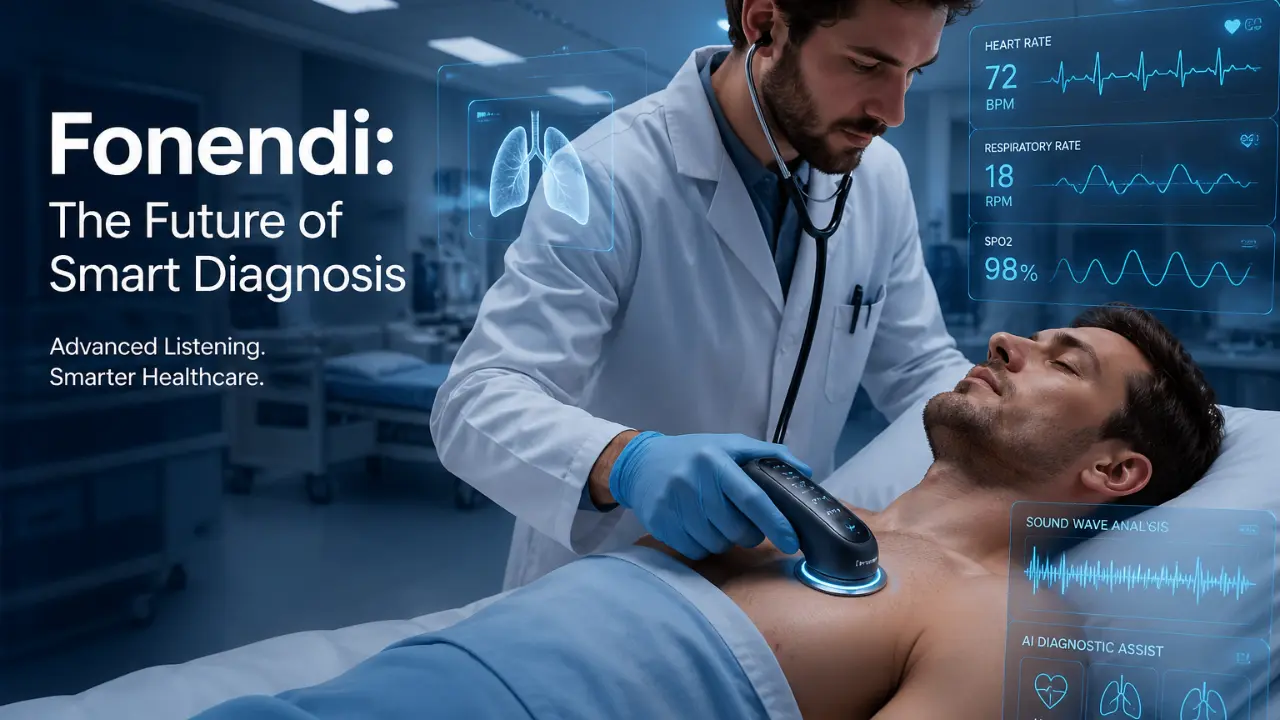
Medical diagnostics has always relied on the ability of clinicians to listen carefully to the human body. Among all clinical tools, the stethoscope remains one of the most essential instruments in healthcare history.
In recent years, however, traditional tools have evolved into smarter systems. One of the most notable advancements in this field is fonendi, a modern digital evolution of the classic stethoscope.
Today, fonendi is not just a listening device. It represents a shift toward intelligent auscultation, combining acoustic science with digital processing and artificial intelligence support.
In modern healthcare environments, where accuracy and speed are critical, fonendi plays an increasingly important role in improving diagnostic precision, especially in cardiology, pulmonology, and emergency medicine.
What is Fonendi?
Fonendi is an advanced clinical listening device designed to capture, enhance, and analyze internal body sounds such as heartbeats, lung activity, and gastrointestinal movement.
Unlike a traditional acoustic stethoscope, fonendi integrates digital sound processing technologies that improve clarity and reduce external noise interference.
From a clinical perspective, fonendi can be described as a hybrid diagnostic instrument combining:
- Acoustic sound capture
- Digital amplification
- Noise filtering systems
- Optional AI-assisted interpretation
In modern medical terminology, fonendi is often classified under digital auscultation systems, a growing category within medical technology.
It is widely used in clinical environments where accurate sound interpretation is critical for early diagnosis.
Clinical Evolution of Fonendi
The development of fonendi is closely tied to the evolution of medical auscultation itself. The earliest stethoscopes, introduced in the 19th century, were entirely acoustic and required direct sound transmission through tubes.
While effective, traditional devices had limitations in noisy clinical environments.
Over time, medical innovation introduced electronic and digital enhancements that improved sound clarity. This evolution eventually led to the modern fonendi system, which combines:
- Traditional chest-piece design
- Electronic signal conversion
- Digital sound enhancement
This transition reflects a broader trend in healthcare: the integration of medical devices with digital intelligence systems to improve diagnostic reliability.
How Fonendi Works
The working mechanism of fonendi can be understood in four clinical stages:
1. Sound Capture
The chest piece detects physiological vibrations from the body.
2. Signal Conversion
These vibrations are converted into digital audio signals.
3. Processing and Enhancement
The system filters noise and amplifies clinically relevant frequencies.
4. Output Delivery
The enhanced sound is delivered through headphones or connected devices.
In advanced models, fonendi technology may also visualize sound waves, enabling clinicians to interpret data more precisely.
This process is aligned with principles of modern Natural Language Processing when applied to biomedical signal interpretation.
Key Features of Fonendi
Modern fonendi systems include several advanced features that distinguish them from traditional stethoscopes:
High-Precision Sound Amplification
Enhances subtle physiological sounds that may be difficult to detect manually.
Noise Reduction Technology
Filters environmental noise commonly found in hospitals and emergency rooms.
Digital Recording Capability
Allows clinicians to store and review patient sounds for comparison.
Wireless Connectivity
Supports integration with mobile devices and hospital systems.
Frequency Filtering Modes
Enables focus on specific body systems such as cardiac or pulmonary sounds.
Smart Visualization (Advanced Models)
Some systems convert audio into waveforms for analytical review.
These features make fonendi a significant upgrade in diagnostic listening technology.
Clinical Benefits of Fonendi
The adoption of fonendi offers measurable advantages in healthcare practice:
Improved Diagnostic Accuracy
Enhanced sound clarity reduces the likelihood of missed clinical signs.
Faster Clinical Decisions
Real-time audio enhancement supports quicker assessment in emergencies.
Better Medical Training
Students can replay and study recorded sounds for learning purposes.
Improved Patient Monitoring
Continuous or repeated recordings help track patient conditions over time.
Support for Telemedicine
Recorded auscultation data can be shared with specialists remotely.
In studies on digital auscultation systems, improved sound clarity has been associated with better detection rates of cardiac murmurs and pulmonary abnormalities.
Use Cases of Fonendi in Healthcare
Cardiology
In cardiology, fonendi helps detect irregular heart rhythms, murmurs, and valve dysfunctions with higher precision.
Pulmonology
It assists in identifying abnormal lung sounds such as wheezing, crackles, or reduced airflow.
Emergency Medicine
Rapid assessment of critical patients becomes more efficient using enhanced sound detection.
Pediatrics
Children and infants benefit from clearer sound amplification due to weaker physiological signals.
Medical Education
Medical students use fonendi systems to train auscultation skills more effectively.
These applications demonstrate how fonendi technology is deeply integrated into modern clinical practice.
Fonendi vs Traditional Stethoscope
| Feature | Fonendi | Traditional Stethoscope |
|---|---|---|
| Sound Quality | Enhanced and amplified | Natural acoustic sound |
| Noise Filtering | Yes | No |
| Recording | Available in digital models | Not available |
| Connectivity | Bluetooth / app support | None |
| Learning Support | Advanced replay system | Limited |
While traditional stethoscopes remain reliable, fonendi systems provide significant technological advantages in complex clinical environments.
Limitations of Fonendi
Despite its advantages, fonendi also has certain limitations:
- Higher cost compared to traditional models
- Requires charging or battery management
- Learning curve for digital features
- Dependence on electronic systems in advanced models
- Occasional signal distortion in extreme noise conditions
These limitations highlight that fonendi is a supportive tool, not a replacement for clinical expertise.
Future of Fonendi in Healthcare
The future of fonendi technology is closely linked with artificial intelligence, remote healthcare, and predictive diagnostics.
Emerging developments suggest:
- AI-assisted sound interpretation
- Integration with wearable health devices
- Cloud-based patient sound databases
- Real-time diagnostic support systems
In the next phase of healthcare evolution, fonendi systems may become part of fully connected digital diagnostic ecosystems used in hospitals and remote care environments.
Conclusion
Fonendi represents a significant advancement in modern medical diagnostics. By combining traditional auscultation principles with digital enhancement, it improves clarity, accuracy, and efficiency in clinical decision-making.
Although it does not replace medical expertise, it strengthens one of the most fundamental clinical skills: listening to the human body.
As healthcare continues to evolve, fonendi technology will remain an important bridge between traditional medicine and digital innovation, supporting better patient outcomes and more informed clinical practice.
Frequently Asked Questions (FAQs)
What exactly is fonendi in modern healthcare?
Fonendi is a modern digital evolution of the traditional stethoscope used for auscultation. It helps healthcare professionals listen to internal body sounds such as heartbeats, lung activity, and bowel movements with improved clarity using digital sound enhancement and noise reduction technology.
How is fonendi different from a traditional stethoscope?
Unlike a traditional stethoscope that only transmits acoustic sound, fonendi uses digital processing to amplify, filter, and sometimes record body sounds. This makes it easier for doctors to detect subtle abnormalities, especially in noisy clinical environments.
Is fonendi useful for medical students and training?
Yes, fonendi is highly beneficial for medical students. It allows them to hear clearer and amplified body sounds, making it easier to learn auscultation skills. Some models also allow sound recording, which helps in repeated practice and better understanding of clinical cases.
Can fonendi improve diagnostic accuracy?
Fonendi can support improved diagnostic accuracy by enhancing sound clarity and reducing background noise. However, it does not replace clinical judgment. Diagnosis still depends on the experience and knowledge of the healthcare professional using it.
Does fonendi require maintenance or special care?
Yes, like any medical device, fonendi requires regular care. It should be cleaned after each use, stored properly, and its components (like eartips and diaphragm) should be checked regularly to ensure accurate performance and hygiene.
