
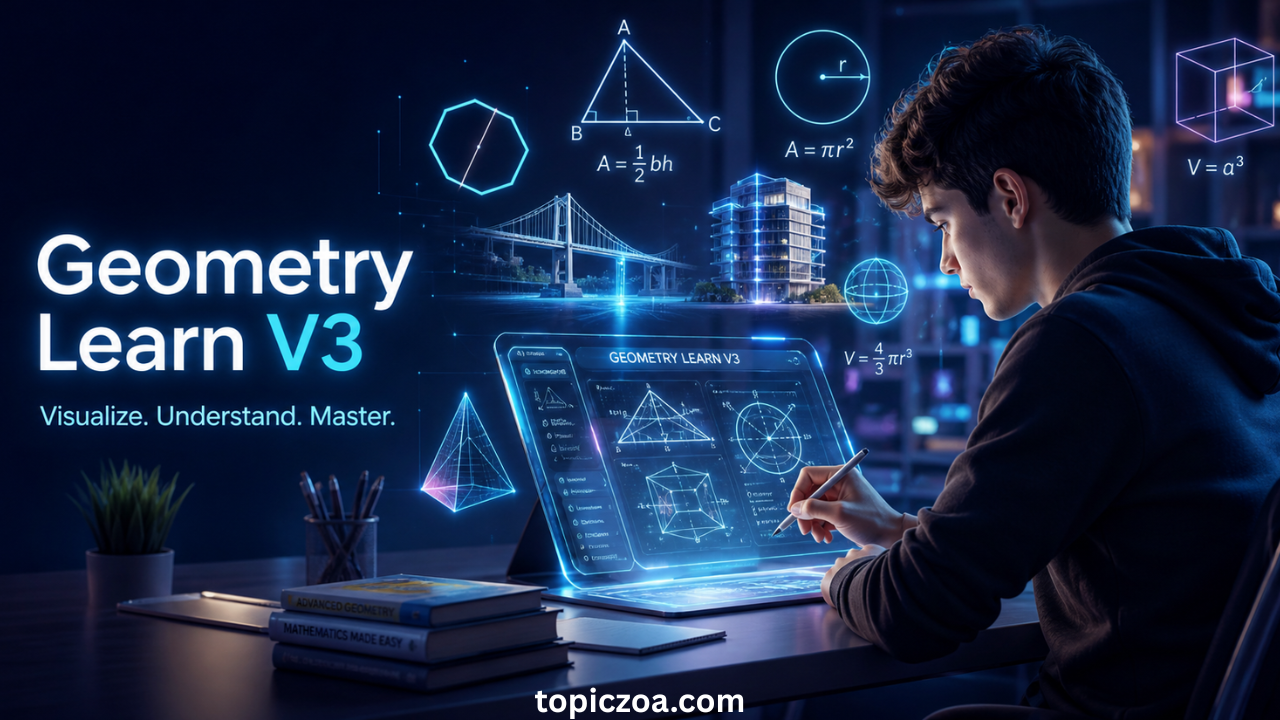
If geometry has ever felt confusing or overwhelming, you’re not alone. Many students struggle with shapes, angles, and formulas not because the subject is hard, but because it’s often taught in a complicated way. That’s where geometry learn v3 comes in.
This modern approach focuses on clarity, visual understanding, and step-by-step learning. Instead of memorizing formulas blindly, it helps you actually understand why things work. Whether you’re a beginner or someone trying to improve your basics, this guide will walk you through everything you need to know.
What is Geometry Learn V3?
At its core, geometry learn v3 is a structured, updated learning approach designed to make geometry easier, more interactive, and more practical.
It’s not just a course or a tool it’s a smarter system that combines:
- Visual learning techniques
- Real-world examples
- Step-by-step problem solving
- Simplified explanations
Unlike traditional methods, this version focuses on understanding concepts instead of memorization. It helps learners build a strong foundation that stays with them long-term.
Key Features of Geometry Learn V3
So, what makes this system stand out?
Here are some of its most important features:
- Visual Learning Focus
Diagrams, shapes, and illustrations make concepts easier to understand. - Step-by-Step Guidance
Every problem is broken down into simple steps. - Beginner-Friendly Structure
Starts from basics and gradually moves to advanced topics. - Interactive Practice
Encourages active learning instead of passive reading. - Concept-Based Learning
Focuses on understanding rather than memorizing formulas.
These features make geometry learn v3 especially helpful for students who struggle with traditional teaching methods.
Why Geometry Learn V3 is Different from Traditional Learning
Traditional geometry learning often looks like this:
- Long lectures
- Complex definitions
- Heavy memorization
- Little real-world connection
The result? Students feel lost and disconnected.
In contrast, geometry learn v3 changes the experience completely.
Instead of forcing information, it:
- Explains why concepts work
- Uses visual examples for better clarity
- Connects geometry to real-life situations
- Builds confidence step by step
This shift makes learning not only easier but also more enjoyable.
Core Topics Covered
A strong geometry system must cover all essential areas. Here’s what you can expect:
- Basic Concepts
- Points, lines, and planes
- Types of angles
- Shapes and Figures
- Triangles and their properties
- Circles and polygons
- Geometry Formulas
- Area and perimeter
- Volume and surface area
- Theorems
- Pythagorean theorem
- Triangle rules
- Coordinate Geometry
- Graphs and plotting points
These topics are explained in a clear and structured way inside geometry learn v3, making them easier to understand.
Benefits for Students
Why should you consider this approach?
Here are the real benefits students experience:
- Better Understanding
Concepts become clear instead of confusing. - Improved Memory
Visual learning helps retain information longer. - Faster Problem Solving
Step-by-step methods reduce mistakes. - Increased Confidence
Students feel more comfortable solving geometry problems. - Practical Knowledge
Learning connects to real-life situations.
Overall, geometry learn v3 helps students move from confusion to confidence.
How to Use Geometry Learn V3 Effectively
To get the best results, follow this simple process:
1. Start with Basics
Don’t skip foundational concepts like angles and shapes.
2. Learn Visually
Always look at diagrams and try to understand them.
3. Practice Daily
Even 15–20 minutes of geometry practice makes a big difference.
4. Focus on Concepts
Ask yourself: Why does this formula work?
5. Review Regularly
Revisit important topics to strengthen your understanding.
When used correctly, geometry learn v3 becomes a powerful learning system.
Real-Life Applications of Geometry Learning
Geometry isn’t just for exams it’s everywhere.
Here are some real-world uses:
- Architecture – Designing buildings and structures
- Engineering – Creating machines and systems
- Art & Design – Patterns, symmetry, and layouts
- Navigation – Maps and directions
- Technology – Graphics and game design
Understanding geometry helps you see the world differently. That’s why systems like geometry learn v3 focus on practical learning.
Common Mistakes Students Make in Geometry
Let’s be honest most struggles come from simple mistakes.
Here are common ones:
- Memorizing formulas without understanding
- Skipping basic concepts
- Not practicing enough
- Ignoring diagrams
- Rushing through problems
Avoiding these mistakes can dramatically improve your performance.
Tips to Master Geometry Faster
Want to learn geometry more efficiently? Try these tips:
- Break problems into smaller steps
- Draw diagrams for every question
- Practice regularly, not occasionally
- Focus on weak areas
- Use real-life examples to understand concepts
Consistency and clarity are the keys to success.
Traditional Learning vs Modern Approach
Let’s compare:
| Traditional Learning | Modern Approach |
|---|---|
| Memorization-heavy | Concept-based |
| Less interaction | Interactive learning |
| Theory-focused | Practical understanding |
| Confusing explanations | Simple and clear methods |
This is why geometry learn v3 is becoming a preferred method for many learners.
Conclusion
Geometry doesn’t have to be difficult. With the right approach, it can actually become one of the most interesting subjects to learn.
geometry learn v3 offers a smarter, clearer, and more practical way to understand geometry. It removes confusion, builds strong fundamentals, and helps students gain real confidence.
If you’ve struggled with geometry before, this approach can completely change your experience. Start small, stay consistent, and focus on understanding not memorization.
FAQs
What is geometry learn v3?
It is a modern learning approach designed to simplify geometry using visual methods and step-by-step explanations.
Is it suitable for beginners?
Yes, it starts from basic concepts and gradually moves to advanced topics.
How is it different from traditional learning?
It focuses on understanding concepts rather than memorizing formulas.
Can it improve exam performance?
Absolutely. Better understanding leads to fewer mistakes and better results.
How long does it take to master geometry?
It depends on practice and consistency, but structured learning makes the process much faster.
